MR H: Do you ever feel that we won't get to the bull's-eye 'together'?
PROF: Do I ever feel that?
MR H: Yes.
PROF: I am positively sure that we won't!
MINI: ...because for one thing, there is that question of 'we'.
PROF: 'We' is just a social convention, and society is just—well, you know for yourself. It's a whole mess of mind.
MR H: It's funny that, because why should mind be messed up?
PROF: Imagine! Mind, so absolutely pure, being messed up by us!
MINI: That sounds really stupid!
PROF: It really does. You'd never think that intelligence was infinite, would you?
MR H: No! You'd definitely say there must be a limit somewhere.
PROF: Yes, and the limit is that it allows for the existence of ourselves, who really are obviously nonsense.
MR H: That's fascinating what you say about allowing for 'us.'
PROF: I think that's what 'love' must mean: that infinite intelligence actually allows for 'us,' when you would think that there was no excuse whatsoever for 'us'!
ME: Right — except just sheer grace!

Worried?
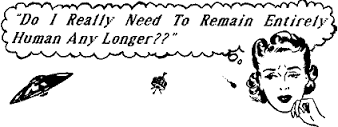
If you feel worried, it must be because you are checking into humanity. Humanity is definitely worried. It is aware that it has overreached itself. And it has its own historical record to confirm the fear that any organism that reaches its fullness tends to collapse in on itself. The crash has just about begun, and everyone is wondering how far it will go, and how it will affect them personally.
WHY BEING HUMAN IS NO GOOD
To be locked into humanhood is like being someone 'glued' to a television screen: just sitting there all day and all night watching it, until sleep takes over. First thing in the morning, on it goes again, to be watched even while eating and drinking.
If the screen is blank, as in the case of boredom, one mutters to oneself: "Oh, well, it's just an interruption in the service. I'll stay watching; it'll come on again in an hour or so, I expect."
Meanwhile, we are totally unaware that the whole universe is flowing through, round and about us all the time! Our attitude and our belief say, "No, no! This is the real. I know because, here it is. And I've got to concentrate on it. Don't disturb me."
Reflecting this way, doesn't it seem moronic to be locked into the human experience like someone fascinated by a television or computer screen? It's cloddish and stunning. What's more, the available programmes don't get any more interesting.
The condition of being locked into the human experience has a fatalistic rigour about it. It's a total belief system. There are numerous beliefs floating about in the human noösphere, causing no end of trouble, but no other belief than this one is necessary. It's a complete, hermetically sealed belief system, already containing all the sub-beliefs such as religion, etc., which attempt to come to terms with the dark side of human living. Bereavement, for instance. But one mustn't worry because there are new ones constantly appearing. Adjust to the flow. That's the way. Grow old, die off.
To finish with this propaganda, one has to find out how to end the fixation on the screen of human experience. The first step must be: all-round awareness, minimizing fixed focus and integrating the senses so as to sidestep thought.
Conversations At IRI- II
PROF: Culture is the crowning achievement of physicality.*
ME: Yes! That's what it's for!
PROF: Well, supposedly, but sadly culture is usually dissipated through over-indulgence, which is not quite the same thing.
*(i.e., work, labour, etc.)
A Hidden Meaning in Castaneda’s Books
A Review of the Works of Carlos Casteneda
The stories about sorcerers who are determined to outwit death and to ‘merge with the intent of infinity,’ as related in the several books by Carlos Castaneda, could be said to be a reflection of the wave of popular interest in exploration of the boundaries of consciousness that was somewhat characteristic of sophisticated Western society some forty or so years ago. Whether the accounts are really true or fabricated has been a matter of heated debate from the first. Whilst they certainly tend to stretch credibility almost to snapping point, there is a curiously attractive element that invites one to believe in the characters and their extraordinary adventures. The reported death of Carlos Castaneda in Los Angeles (1998) from an ugly disease must have been something of a blow for those readers who had no trouble believing in the stories.
Their relevance today? Well, whatever one cares to believe about the veracity of the story itself the work contains, through implication, a thorough critique of the human ethos. So skilfully is it woven into the texture of the tales that it may well have passed unnoticed, intentionally or otherwise, by millions of readers. Concealed in the romance of sorcery and magic is a totally disenchanted view of human society. The characters in the story simply turn their backs on humanity, occupying themselves instead with their all-absorbing interest: 'the mastery of awareness,' the abandonment of the ‘inner dialogue’ and the exploration of dimensions outside ordinary perception. Though the implied critique of humanity is easy to overlook or ignore, it interestingly amounts to a complete dismissal: why should anyone so passionately desire to leave forever the comfort and reassurances of normal association to travel the relatively lonely and often deeply disturbing path of sorcery?
Further, it appears that these stories are specifically to do with ways and means of leaving the repetitious cycles of the human world; the characters are wholly concerned with such departure and are not concerned with the global doings and importance of humankind—except in so far as human conditioning is considered to be the most serious impediment to the way of infinite freedom.
The ‘mastery of awareness' is deemed necessary in order to attain complete freedom from the binding conception of the known world, not so as to impress other people with acquired personal powers but in order to achieve freedom or ‘the totality of oneself.’ The sole concession to what might be called 'social consciousness' is to know how to behave so as not to attract unwanted attention and interference. The adepts-in-training simultaneously set about extricating themselves from society: this is the first step to being free, because as far as society is concerned, its patterns amount to the only known truth and no-one can escape its obsessive documentation. It is therefore seen to be vitally necessary to ease oneself out of the grip of the belief in social truth. Obviously this is an arduous task, due to a host of pressing survival concerns, such as bills, responsibilities, commitments, fears and unsatisfied desires.
The character of don Juan is, through Carlos' relative slow-wittedness and his reluctant curiosity, able to reflect accurately the quality of being human in all its complexity and deviousness. That humanity is not a worthwhile investment for the free spirit is regarded by don Juan as self-evident. That one should use every possible means to dissolve one’s hapless fixation is unquestionably the only right thing to do!
It is likely that more than a few readers of these books have actually journeyed to the Mexican desert, particularly from the neighbouring US, in search of characters like those described or in order somehow to find their own way to fulfillment. This reviewer doesn’t think that going anywhere in particular or trying to secure ideal conditions can awaken an interest in the infinite mystery that surrounds us and in the source of awareness: that must happen from ‘within,’ as it were, regardless of circumstances. To encourage us all, we have these exhuberant, joyful, whimsically humorous stories centering on the play of ‘power’ among some of the most engaging characters ever to have left the earth for inconceivable adventures.
The Yoga of Thought Transcendence
A look at some pertinent quotations from the Ati Yoga Text, which begins:
Having studied the Dzog Chen Text entitled Cultivating the Primordial State of Pure and Total Presence by Mañjuśrīmitra,* otherwise known as the Ati Yoga Text, IRI set out to scrutinize it carefully for further clarification, resulting in the following questions and answers. (Verse numbers from the original Text are included for reference.)
*(as translated by Namkai Norbu, Kennard Lipman and Barrie Simmons in the book Primordial Experience.)

"To the Joyful One, (who has fully grasped) that there is nothing that makes both (persons and phenomena) what they are, who has acquired everfresh awareness untainted by concepts, and primordial contact with the total field of events and meanings;
To the quiet nature of everything, the supreme path in which there is nothing to accept or reject;
To those who are one with all the Victorious Ones, (and possess) the ten powers, such as never turning back;
To the very sameness of these three places of refuge, I very confidently dedicate myself, without conceptualizing (this sameness)."
To the quiet nature of everything, the supreme path in which there is nothing to accept or reject;
To those who are one with all the Victorious Ones, (and possess) the ten powers, such as never turning back;
To the very sameness of these three places of refuge, I very confidently dedicate myself, without conceptualizing (this sameness)."
Having studied the Dzog Chen Text entitled Cultivating the Primordial State of Pure and Total Presence by Mañjuśrīmitra,* otherwise known as the Ati Yoga Text, IRI set out to scrutinize it carefully for further clarification, resulting in the following questions and answers. (Verse numbers from the original Text are included for reference.)
*(as translated by Namkai Norbu, Kennard Lipman and Barrie Simmons in the book Primordial Experience.)
_______________________________________________________________________________
TEXT: ‘The greatest skilful action is this hidden activity of those committed to pure and total presence.’ (134)
Q: Is it hidden because it is not objective action, not from one to another, not accessible to ordinary vision?
A: This question answers itself well, but more pondering and less attack should make undeniably plain why such action is termed 'hidden.'
TEXT: ‘When one has thoroughly understood that there are no ‘entities’, everything then arises as the total field of events and meanings - understanding this is the supreme state of those who have overcome emotional conflicts’. (115)
Q: The intuition of there being no entities seems to be clear at some times, and hazy at others. Is emotionality managed entirely by self-discipline, or does it no longer arise because the non-existence of self is fully understood?
A: There are no entities in perceiving; those are all the product of a conceptualising activity. As to the sharpness of focus, it continually shifts, since nothing is really fixed. Calmly riding the emotional currents that seem to arise in us should be a good way to 'overcome emotional conflicts.' Finally, alert to any advertising copy, we do not concern ourselves with a 'supreme state.'

TEXT: ‘The variety of experience pertinent to each appears through their own habitual mode of vision.’ (63)
Q: Does this refer to each being in a personal dream? It seems that keen students of the way of truth are able to synchronise their vision by living the same life and acknowledging reality as the basis.
A: Our experience is the product of habit. Living in proximity and examining from moment to moment, alone and together, what could be the total significance of our living is the best way to help each other not to lapse into false positions. The latter are known by their attendant vexation.
TEXT: ‘Since, if one enquires into our limited idea, ‘entities’, they are found to be non-existent even as regards their apparitional nature........’ (92)
Q: How is it, then, that we see each other?
A: Do we not see each other by means of a potentially infinite complex of misinformation* known as the human condition? Since the complex is bound to be unfathomable in its potential, it would be futile to search in it for a fundamental means or cause. We must therefore be satisfied that the capability to see each other is the best possible starting point for our investigation of ultimate meaning.
* Why 'misinformation'? Well, if we knew our 'information' to be correct in whole and in part we should surely be inseparable from ultimate meaning and would have no use for further study!
TEXT: 'Grasping experience through thought, which is the sphere of operation of our ‘mind,’ is itself the ultimate content of what is.’ (112)
Q: Does ‘the ultimate content of what is’ refer to appearance? Is appearance then created through thought? Can there be experiencing without thought?
A: There is no 'ultimate content.' Content requires containment and a container. 'Appearance' is an empty concept, i.e., it does not contain anything. Let us say that in our experience, there is our world of sensorially perceptible thought and a corresponding non-world of imperceptible thought. If, on the other hand, one is thinking of life without thought, then the idea of experiencing can simply be dispensed with. Inconceivability is then one's middle name, as it were!
Q: Is it hidden because it is not objective action, not from one to another, not accessible to ordinary vision?
A: This question answers itself well, but more pondering and less attack should make undeniably plain why such action is termed 'hidden.'
TEXT: ‘When one has thoroughly understood that there are no ‘entities’, everything then arises as the total field of events and meanings - understanding this is the supreme state of those who have overcome emotional conflicts’. (115)
Q: The intuition of there being no entities seems to be clear at some times, and hazy at others. Is emotionality managed entirely by self-discipline, or does it no longer arise because the non-existence of self is fully understood?
A: There are no entities in perceiving; those are all the product of a conceptualising activity. As to the sharpness of focus, it continually shifts, since nothing is really fixed. Calmly riding the emotional currents that seem to arise in us should be a good way to 'overcome emotional conflicts.' Finally, alert to any advertising copy, we do not concern ourselves with a 'supreme state.'

TEXT: ‘The variety of experience pertinent to each appears through their own habitual mode of vision.’ (63)
Q: Does this refer to each being in a personal dream? It seems that keen students of the way of truth are able to synchronise their vision by living the same life and acknowledging reality as the basis.
A: Our experience is the product of habit. Living in proximity and examining from moment to moment, alone and together, what could be the total significance of our living is the best way to help each other not to lapse into false positions. The latter are known by their attendant vexation.
TEXT: ‘Since, if one enquires into our limited idea, ‘entities’, they are found to be non-existent even as regards their apparitional nature........’ (92)
Q: How is it, then, that we see each other?
A: Do we not see each other by means of a potentially infinite complex of misinformation* known as the human condition? Since the complex is bound to be unfathomable in its potential, it would be futile to search in it for a fundamental means or cause. We must therefore be satisfied that the capability to see each other is the best possible starting point for our investigation of ultimate meaning.
* Why 'misinformation'? Well, if we knew our 'information' to be correct in whole and in part we should surely be inseparable from ultimate meaning and would have no use for further study!
TEXT: 'Grasping experience through thought, which is the sphere of operation of our ‘mind,’ is itself the ultimate content of what is.’ (112)
Q: Does ‘the ultimate content of what is’ refer to appearance? Is appearance then created through thought? Can there be experiencing without thought?
A: There is no 'ultimate content.' Content requires containment and a container. 'Appearance' is an empty concept, i.e., it does not contain anything. Let us say that in our experience, there is our world of sensorially perceptible thought and a corresponding non-world of imperceptible thought. If, on the other hand, one is thinking of life without thought, then the idea of experiencing can simply be dispensed with. Inconceivability is then one's middle name, as it were!

Consider This
how do enormous increases in population cause commensurate confusion in the people and their governments?
The facility for taking part
in the cult of personality*
is the booby-prize
for failure to acknowledge overpopulation.
(*worshipping or being worshipped)
The cultivation of personality
clearly builds up the fear of death.
clearly builds up the fear of death.
Goodness
From a discussion of manners, as dependent on character and position:-
PROF: No one has any position anymore. They are all just like travellers! They are rough; there are no sharply defined roles. There may be some in London—I don’t know—but what you get in the street is just a rabble of travellers.
MINI: And when you get sharply defined roles, it’s hard to believe there is anything in it apart from business.
PROF: Absolutely. Yes. They’ll only be top business executives if they are smart.
ME: There always seemed to be a lot more in it (in the past) than that. There was honour, for instance.
PROF: Oh yes, there was a whole lot — all completely gone. People don’t believe it anymore. It’s not part of the moral setup anymore. Now, they’ve got a single standard, which is money.
MINI: We were looking at that recently, and thinking, “What does ‘good’ reduce to?” What is the meaning of ‘good’!
PROF: Yes, and I came up with a definition of which I am really quite proud:
‘Goodness in Humankind comes down to the ability to Experience Pleasure.’
Amazing. I never quite thought of it like that before.
ME: And religion is like the politics of goodness.
PROF: But religion has been sidelined today, so I don’t really think it’s relevant. It is not part of the mass mind today. It’s only a very small section that still believes it.
MINI: Religion is a little bit like conservatism — the idea is that you save up so you can have a real experience of pleasure at some other time.
PROF: You go without a little bit. Even Krishamurti mentions that: “Self-denial is part of the way.” All that that can mean is you are saving up; saving up for a better experience!
MINI: Christianity at root is: you can save up for the pleasure of heaven.
Later on, the subject of ‘fame’ was touched on, as well as the impossibility of talking to anyone due to emotional misunderstandings. I had been reading Alexander Pope, and thought that “in spite of Pope’s love of wordplay, if he were faced with the wordless, thought-free study, he would have ‘bowed-out’ and absented himself; in other words, he would have completely understood and ‘left the stage’,” but my words were taken by the others in a somewhat different light:-
MINI: When ordinary people get any inkling of the study, their immediate response is just to withdraw — “I didn’t see that,” or, “What they are talking about is nothing.”
PROF: Yes, and as far as the study is concerned, they thereby reveal that they are not, which is what they are! Don’t they? They don’t ‘bow out.’ They just....don’t! The creature isn’t really curious about the ultimate facts at all.
MINI: No, and you’ve illustrated why: the main point and focus is actually the pursuit of pleasure...
Prof: ...that fuzzy warm feeling that life’s alright.
But you can’t talk about this, because people will think you are condemning pleasure: “No pleasure. Right. OK.” Hopeless, with people! They would have to take an interest in this matter; if they don’t, you can’t do anything with them.
I mean, in my own case, it’s rather sad (said he, eyes glinting, looking anything but sad!) that I’ll never become famous (but doing his level best to sound pathetic). Because, awh, you know, I can’t actually promote the study in any way, and you have to admit, that’s a bit sad...
ME: Do you really feel that it’s sad?
PROF: Hmmm (childish indignation)
MINI: But I know that you would run a mile from anything to do with fame!
PROF: But wouldn’t I be chuffed if somebody approved of my sayings?
ME: I think you’d be happy.
PROF: Well that’s the same thing, isn’t it?
ME: I think it’s not so much the approval, as someone actually being able to understand and appreciate it. It’s more than approval.
PROF: More than approval?!
ME: Well, approval is just social.
PROF: You mean it’s an intensified sort of approval...
MINI: Of course, we’d be glad.
PROF: Let’s try and make a hypothesis, then, in which for once, what I say is approved of outside our little circle.
MINI: Yes, just suppose that XX Publications, instead of sending the usual rejection had said, “Yes, that sounds interesting. We agree. It’s time for a book about acknowledgement to be produced and written, and we’d like to see an outline, and please give us your ideas.”
PROF: Thank goodness they didn’t!! (Laughter) Well, because then you are obliged. You are obligated.
ME: But you could do it all very quickly.
PROF: Hmm, I’m not so sure if I was obligated.
MINI: Oh no! You’d do it very easily! We’d help you. We’ve got all the material.
ME: You take even a letter as an obligation, and answer it very quickly.
PROF: I s’pose that’s true.
MINI: Well for one thing, if there were interest shown, the point is, that it should not be directed to a personality.
PROF: Oh, absolutely. That’s what I would run away from: that’s the mistake - that’s a grave error of the first water. To focus on personalities: it’s what they do today a lot, and you know that it’s so distasteful. They think that by bandying names about they get people interested. If people are interested in that - they are just no better than chickens, pecking about for a grain of truth!
"The Perceived Cannot Perceive"* - Discuss
(From a letter to a friend)
* - a quote from Huang Po
"As to the presence or absence of selfhood, what is meant is that there can exist no absolute, objective entity, whether actually or purely cognitive. The reason of humans is, as you know, based quite firmly on belief in a probable infinity of discrete though interdependent entities, animate, inanimate or as yet unclassified, each doing its bit in an immeasurably vast scheme of things. To argue with such a view would be worse than futile, but it is possible to scrutinize it in the immediacy of presence, whereat it immediately dissolves.
"The notion that consciousness is personal is actually assumed; the assumption is also what we understand as selfhood. Ideas of trying to rise above the sense of personal centeredness ('enlightenment') must fail and plunge into the ocean of actuality. Eventually, one comes to suspect that the ever-searching thought process must give way to this unoccupied actuality."
"The notion that consciousness is personal is actually assumed; the assumption is also what we understand as selfhood. Ideas of trying to rise above the sense of personal centeredness ('enlightenment') must fail and plunge into the ocean of actuality. Eventually, one comes to suspect that the ever-searching thought process must give way to this unoccupied actuality."
* - a quote from Huang Po
Subscribe to:
Posts (Atom)